


EXCLUSIVE: Emile Heskey's World Cup memories, from facing Ronaldo to Capello's fury
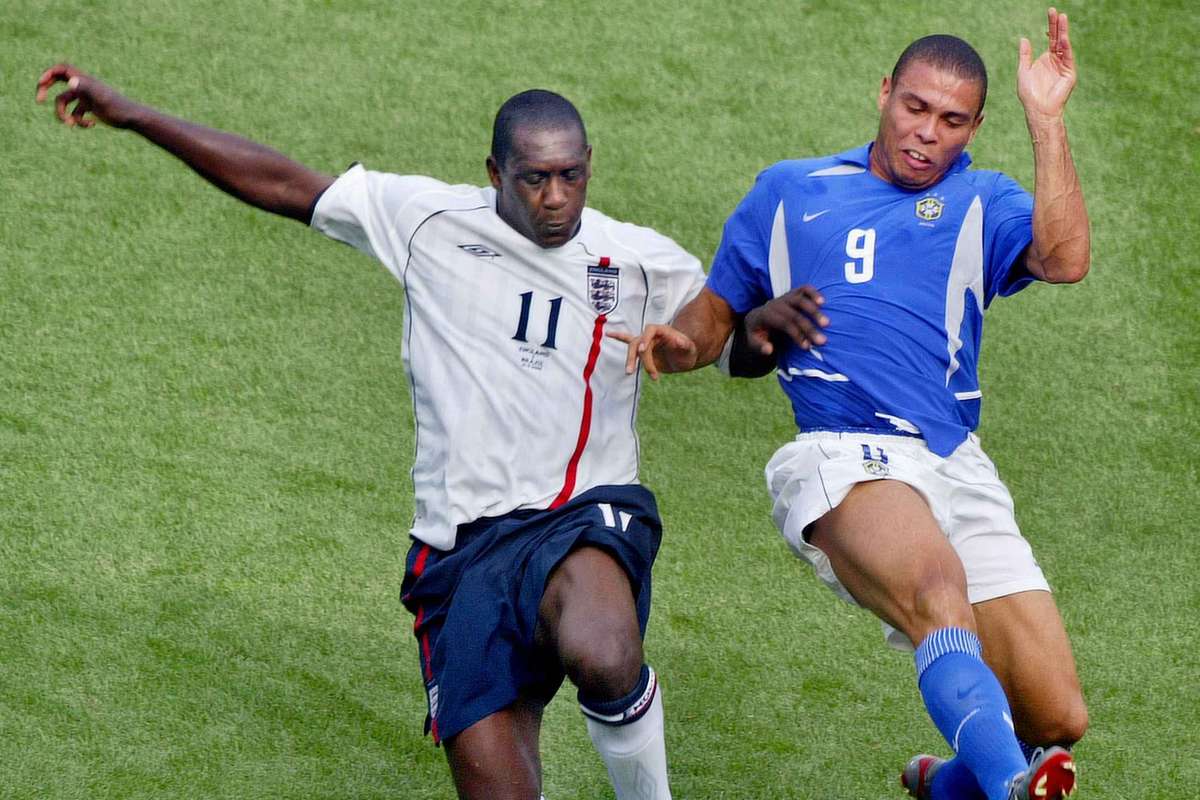
Although he made his debut in 1999 and appeared twice as a substitute during EURO 2000, Heskey's England career truly ignited a year later.
On a rainy evening in Munich in September 2001, the then-Liverpool forward scored to complete a famous 5-1 victory over Germany in a World Cup qualifier, a match he described to Flashscore as the finest of his career.
Firmly establishing his importance to Sven-Goran Eriksson's team, it ensured he would realise one of his greatest ambitions the following year, when he was selected as one of 23 players to travel to South Korea and Japan to represent England at the 2002 World Cup.
"Absolutely among the best," says Leicester-born Heskey when asked where playing at the World Cup ranked in his career highlights.
"As a child, you always have those memories of watching the World Cup. I watched John Barnes, and Gary Lineker, who's from Leicester, so I watched him score loads of goals. And then you dream of playing in one."
Even though he lived that dream at the age of 24, he quickly discovered it came with its own set of challenges.
"It's not easy," he explains.
"You're getting along with each other, and you have to remember that many of us grew up together. I obviously knew Michael (Owen), and I was playing for Liverpool at the time, so I knew a few Liverpool players, but... It's an interesting situation because you're in a foreign country but you don't get to see it. You only see your hotel rooms and different rooms within the hotel.
"Boredom is a tough issue," he continues. "Especially for players who don't enjoy their own company, and there were quite a few of them."
However, Heskey and the England squad managed to get out and explore a little during the 2002 tournament, thanks to the celebrity status of one of his teammates.
"We were fortunate; we had David Beckham. He would close down a shopping centre, and then we would go and just walk around the mall, mainly just to escape the hotel."
On the pitch in Asia, England finished second in their group thanks to a 1-0 win over Argentina. Heskey then scored his first World Cup goal in their 3-0 victory over Denmark in the round of 16, but a star-studded Brazil side claimed a narrow 2-1 win to knock them out.
It is a defeat that still stings for Heskey, who believes he and his teammates could have achieved something special that summer.
"If it wasn't for Ronaldo, Rivaldo and Ronaldinho, we would probably have had a really good chance of winning that...
"It was (painful), and for me personally, I wasn't ready to go home. I was ready to go further."
The striker remained an important part of the England setup after that, but fell out of favour after EURO 2004, not being called up for over three years. During that time, however, he never doubted that he would represent his country again.
"I knew I was going to play again," he recalls. "I knew what I could give and what I could bring. It was only a matter of time."
He was proven right, thanks in large part to Owen. The two had forged a close connection during their time as strike partners for both Liverpool and their country, and the 2001 Ballon d'Or winner convinced England manager Steve McClaren to bring Heskey back into the fold in 2007.
"It was Michael. Michael had a word. He said, 'Bring him back in,' and yeah, I came back in then, and then stayed in."
England missed out on EURO 2008, failing to qualify, and that led to the appointment of esteemed manager Fabio Capello, who was tasked with taking them to the 2010 World Cup.
Capello took a liking to Heskey, who became his first choice for the spot next to Wayne Rooney up front. But while Heskey himself never had an issue with it, the Italian's direct approach ruffled many feathers.
"He was very harsh with some things. He would scream and shout, which I was fine with because I had been in and around that environment anyway in academy football, but some people couldn't really deal with that, and they didn't like it.
"I had frustrated him a couple of times and he would scream and throw things."
Ultimately, Capello's approach was not successful. His side barely survived the group stage in South Africa after draws with the USA and Algeria before losing 4-1 to Germany in the round of 16.
While Heskey feels that the 2002 edition was the more successful of the two World Cups he played in, he puts that down to the quality of the players more than the differences between Eriksson and Capello.
"I think it was just better playing quality, to be honest with you," he responds when asked why things went better in 2002.
"We had some really, really top players. I'm not saying that we didn't at this one (2010) as well, but I just felt that we had a little bit more in 2002."
That era of the English national team is largely viewed as a disappointment, with what was called a Golden Generation never getting further than the quarter-finals at a World Cup or European Championship, also falling at that stage in 2004 and 2006.
However, Heskey does not entirely agree with that assessment, arguing that plenty of other major nations were equally as strong at the time, picking out the talent that France, Portugal and Brazil had to call upon: "Everyone had their own golden generation at that time."
That being said, he cannot help but wonder what could have been for him and his fellow members of the class of 2002 in particular.
"I think that was the closest we ever got."