


What South Africa Should Alter Ahead of Their Second World Cup Match Against Czech Republic
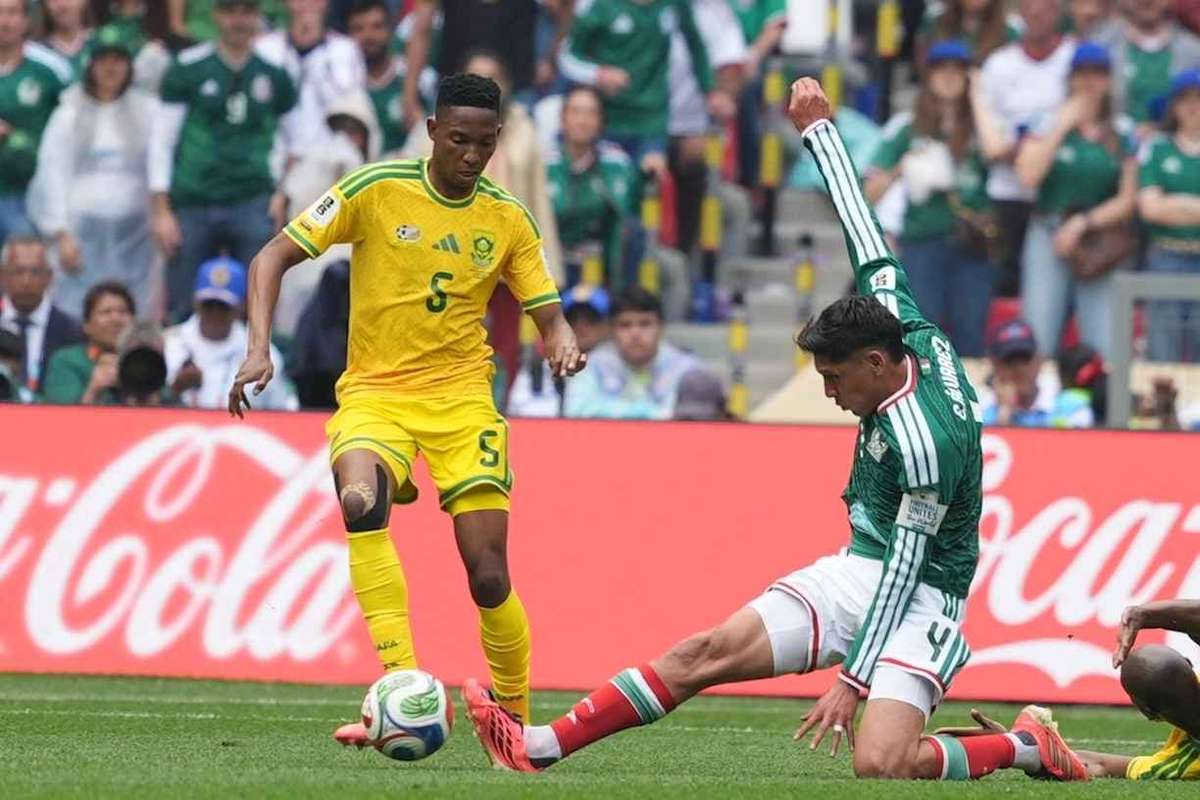
This is despite enduring two red cards, few opportunities at goal and a performance that drew astonishment from pundits around the globe at how inadequate it was.
Coach Hugo Broos believed his team had performed well, despite 39% possession, two shots on target and a pass completion rate of 81%.
Many of those poor passes occurred in the final third, a point highlighted by defender Nkosinathi Sibisi afterwards, though he too felt the performance was acceptable.
“It was just the final ball whenever we were attacking that was lacking," he told SABC Sport. “We know what we have to do. We have to go back, analyse and recover so that we can be as fresh as possible for the next game.
“The opportunity is still there so not all is lost, and I think we saw some glimpses of what we can do, but it just wasn't enough."
So what do they need to do to get back on track against a physical Czech side?
Here are some changes Broos can make for the second game.
Go to a back four
This could be one of the more intriguing questions. The Czechs will be more direct than the Mexicans were and test Bafana aerially, without the same quick-passing threat that Mexico posed around the box.
Bafana looked a little uncertain with a back three, something they have rarely played under Broos and certainly not in a long time.
Sibisi and Mbekezeli Mbokazi should not be the centre-pairing against the Czechs as they are both relatively short. The latter is a shoo-in to start though, so likely with Ime Okon beside him and Khuliso Mudau and Aubrey Modiba in the full-back positions.
Play two in defensive midfield
This is an area where Bafana can be overrun, but perhaps these players need to sit deeper and not open the space in front of the back four.
Teboho Mokoena is sure to start and, in the red-card absence of Yaya Sithole, it is then a toss-up between Thalente Mbatha and Jayden Adams. The latter should get the nod, with Mbatha coming in off the bench.
The option for all three will limit Bafana in attack and they cannot afford to have the same lack of outlet again against the Czechs.
Start Relebohile Mofokeng
Under Bafana’s usual system, it would be a straightforward toss-up between Relebohile Mofokeng and Themba Zwane to start in the playmaking role behind the striker.
Zwane is serving a red-card suspension, so it has to be Mofokeng and deservedly so.
He was the best player in the Betway Premiership last season and a driving force for Orlando Pirates winning the title.
He can be a creative fulcrum and Broos needs to trust the 21-year-old that he can deliver on this stage. All the evidence so far points to the fact he can.
Play with genuine wingers
The Czechs don’t like skilful players who run at them and Bafana have a real chance to isolate the full-backs and take them on.
Oswin Appollis has to start, and Thapelo Maseko would be a good shout on the other wing ahead of Tshepang Moremi.
Who goes on which side does not really matter and they can switch during the game, with both adept on either flank.
Stick with Lyle Foster
Foster remains the best bet for Bafana up front in the formation they would choose to play in this scenario.
Evidence Makgopa is not as adept at holding up the ball, though he is better in aerial duels, while Iqraam Rayners is the kind of striker you look to get in behind the defence.
Bafana want someone who can keep the ball and bring the wingers and Mofokeng into the play. Foster has struggled with form of late, but has played this role expertly before.
If they need to go more direct later on, Makgopa is the man to win things in the air, though he will be up against a tall defence that gives little away off the ground.
Be positive, relax
Bafana set up too negatively against Mexico and it played into the latter’s hands.
It is perhaps understandable, but also goes against the natural inclination of most of the players.
That negative formation feeds into the psyche of the players. The only way they can be successful is to try and be on the front foot more and apply pressure back onto their opponents.
That is not to say all-out attack, far from it, but find a better balance between trying to hold their shape defensively and having an attacking outlet when they have possession.
And stop trying to play out from defence; they do not have the quality on the ball to be successful at that.