


Four years on from excluding Russia, FIFA and IOC remain subdued amid ongoing conflicts
Four years following the swift exclusion of Russia from international sports due to its invasion of Ukraine, major oversight organisations are responding cautiously to the US backed strikes against Iran, prompting claims of inconsistent application of rules.
Each conflict erupted shortly after a Winter Olympics concluded but prior to the Paralympics and an upcoming summer World Cup.
Russian forces entered Ukraine just four days following the end of the 2022 Beijing Winter Olympics. American and Israeli airstrikes began targeting Iran six days after the conclusion of the Milan Cortina Winter Games.
In 2022, it required only four days for soccer's global and continental authorities, FIFA and UEFA, backed by the International Olympic Committee (IOC), to bar all Russian and Belarusian sides.
The IOC denounced the breach of the Olympic Truce by the Russian authorities and the Belarusian regime supporting it.
On this occasion, the IOC has simply requested assurances for the protection of athletes heading to the Paralympics in Italy, especially those potentially impacted by the latest hostilities.
FIFA's Secretary General Mattias Grafstrom indicated that the organisation is keeping a close watch on developments.
Some analysts have pointed out that Russia faced expulsion from FIFA events after invading Ukraine, yet there seem to be no deliberations on comparable measures against the US, according to Simon Chadwick, an expert in sports geopolitics at EMLyon business school.
The conflicts differ in nature.
Russia initiated a ground assault with territorial gains as an explicit objective. Such aims have not featured in the rationales for the US Israeli aerial campaign.
Obvious evasion
Conducting this summers expanded 48 team World Cup without the United States, a co host, would prove challenging, whereas excluding Russia in 2022 before a European playoff against Poland resolved an issue.
Russia, which hosted the 2018 World Cup, had begun European qualifiers but was already sidelined from the 2022 Qatar tournament due to an extended probe into state supported doping. Banning Russia enabled FIFA to sidestep possible awkwardness.
Currently, FIFA President Gianni Infantino, typically active on social platforms, has chosen silence.
This represents clear evasion, Pim Verschuuren, an authority on sports management and geopolitics at the University of Rennes II in France, shared with AFP.
He suggested that Infantino and IOC leader Kirsty Coventry are demonstrating pragmatism given the geopolitical context.
In 2022, immense political demands compelled the IOC to bar Russians, he explained. Today, it cannot risk isolating or provoking the United States.
Besides co hosting the World Cup, the US is set to host the 2028 Olympics in Los Angeles.
There exists a kind of dominance in sports administration, Verschuuren noted. Sports governance is controlled by the United States, bolstered by funding from its Gulf partners.
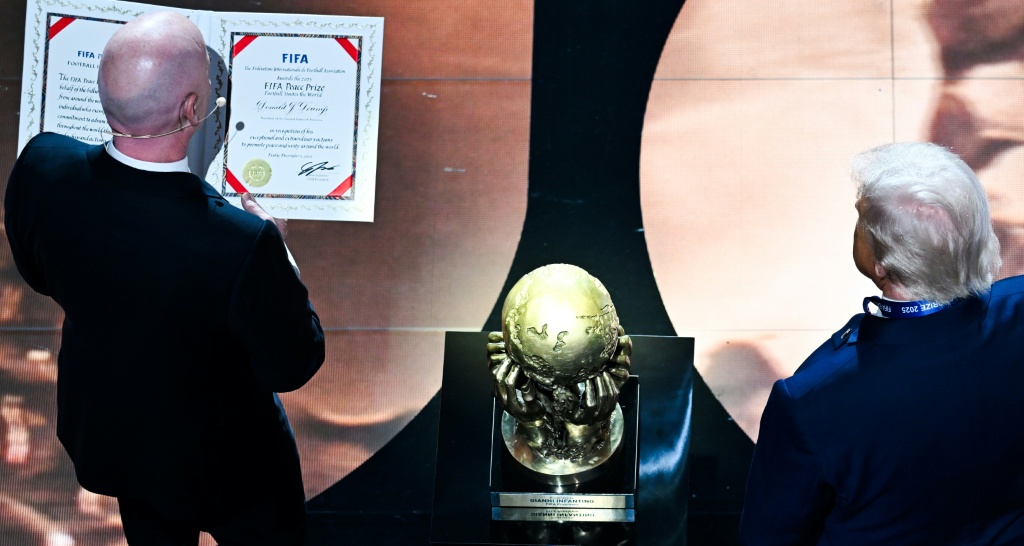
Although the IOC seeks to distance itself from Washington, Infantino is fostering ties with the US leadership, even devising a dedicated FIFA Peace Prize for Donald Trump.
This goes beyond absurd, an insider from soccer's regulatory entities confided to AFP. Yet it makes sense, as he aims for a smooth World Cup.
Beyond absurd
Iran ranks just behind Russia among the most sanctioned nations globally, and enduring limitations have rendered it economically detached. Despite qualifying, it risks absence from the World Cup.
It proves difficult to identify nations that might protest such an outcome, Chadwick remarked, noting its sports sector is so minimal as to be virtually unnoticed worldwide. Eliminating Iran would carry negligible commercial, economic, or political weight.
Removing an opponent would allow Donald Trump and his administration the platform to promote their desired image and principles.
Irans strongest supporters provide scant assistance. Russia, whose competitors can once more display their flag at the Paralympics, is prioritising the lifting of its exclusions. China holds limited sway in global soccer and has adopted a subdued Olympic stance since 2022.
Verschuuren indicated that sports institutions find themselves ensnared similarly to numerous nations and global entities confronting Trumps aversion to collaboration.
The concept of multilateralism is disintegrating, with sports forming part of this decline. The IOC appears entirely disconnected, much like a UN body, Verschuuren observed.